
This article covers whether Benadryl is safe for dogs, the correct dose based on body weight, which formulations to use and which to avoid, which conditions it actually helps with, and which side effects to watch for. Every question a dog owner has about Benadryl before giving it to their dog is answered here.
Your dog is scratching relentlessly, her face is slightly swollen after a walk, or you have a long car journey tomorrow and want to take the edge off her travel anxiety. Benadryl is in the medicine cabinet, and the question is simple: Is it safe to give to a dog? The short answer is yes: plain diphenhydramine (Benadryl) is generally safe for most healthy dogs and is one of the few human medications that vets commonly recommend for home use. The longer answer, with the specific doses and the critical warnings, is what this article covers.
Is Benadryl Safe for Dogs?
Plain diphenhydramine, the active ingredient in standard Benadryl, is generally safe for healthy adult dogs. It is an antihistamine that works by blocking H1 receptors, reducing the body’s response to allergens. Vets recommend it regularly for mild allergic reactions, insect stings, and situational anxiety. It has a reasonable safety profile and a wide therapeutic range, meaning the gap between a therapeutic dose and a dangerous dose is relatively large.
There are dogs for whom Benadryl is not safe. Dogs with glaucoma should not take diphenhydramine, as it increases intraocular pressure. Dogs with heart disease, hyperthyroidism, seizure disorders, or urinary retention issues require vet clearance before taking any antihistamine. Pregnant or nursing dogs should not be given Benadryl without vet guidance. If your dog has any existing health condition, check with your vet before giving any medication, even one considered generally safe.
Benadryl Dosage for Dogs by Weight
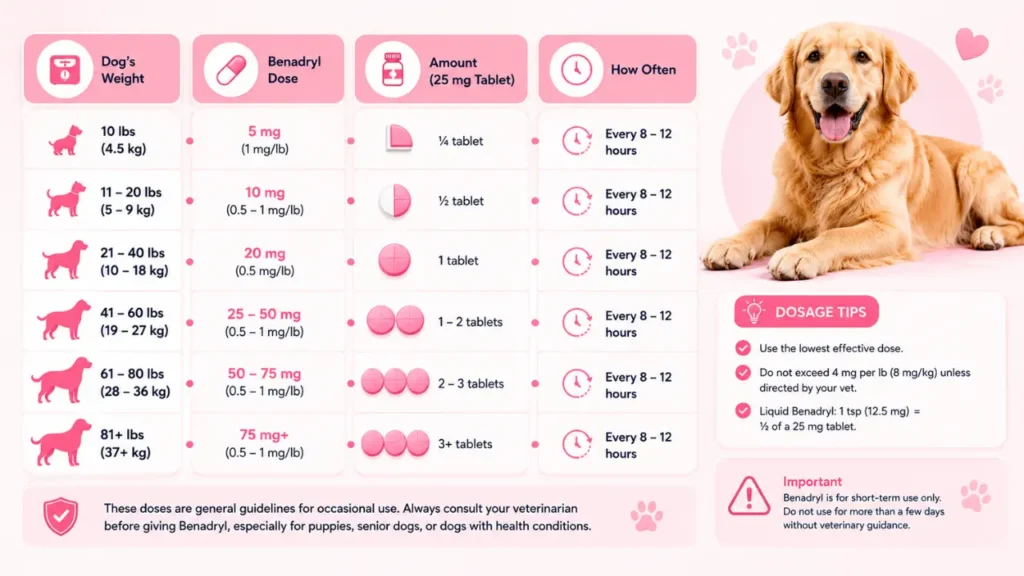
The dose is simple to calculate, but the formulation you choose is just as important as the amount. Giving your dog the wrong type of Benadryl, regardless of the dose, can cause serious harm. Read this section carefully before you open any packaging.
The standard dosage rule
The widely used dosing guideline for dogs is 1 milligram per pound of body weight, administered up to 3 times per day, approximately every 8 hours. The maximum single dose is generally capped at 50 milligrams, regardless of the dog’s size. Always round down, not up, when calculating. A dose slightly below the target is safer than one slightly above it.
Dosage reference by weight
10 lb dog: 10 mg per dose. 20 lb dog: 20 mg per dose. 30 lb dog: 30 mg per dose. 50 lb dog: 50 mg per dose. 75 lb dog: 50 mg per dose (cap applies). 100 lb dog: 50 mg per dose (cap applies). Standard Benadryl tablets come in 25 mg. A 50-lb dog would receive 2 tablets. A 25 lb dog would receive one tablet. Use the Benadryl Dosage Calculator on Doggy Calculators to confirm the dose for your dog’s exact weight.
Tablet vs liquid Benadryl: Which to use and why it matters
Tablets are strongly preferred for dogs. Many liquid Benadryl formulations contain xylitol, a sugar substitute used to improve palatability in children’s liquid medicines. Xylitol is highly toxic to dogs. Even a small amount can trigger a rapid, severe drop in blood sugar and cause liver failure. It can be fatal. Before giving your dog any liquid formulation of Benadryl or any other liquid antihistamine, read the full ingredient list. If xylitol, xylitol alcohol, or birch sugar appears anywhere on the label, do not use it. It is the single most important safety point in this article.
Never give your dog Benadryl formulations
Benadryl-D contains pseudoephedrine, a decongestant that is toxic to dogs and can cause dangerous increases in heart rate and blood pressure. Any “non-drowsy” Benadryl formulation may contain different active ingredients that are not safe for dogs. Any product that combines diphenhydramine with pain relievers such as acetaminophen or ibuprofen must never be given; both are toxic to dogs. Always check that the only active ingredient listed is diphenhydramine.
How quickly does it work, and how long does it last?
Benadryl begins working in approximately 30 minutes after ingestion. Its effects last between 4 and 8 hours in most dogs. For travel anxiety or noise phobia from fireworks, give the dose 30 to 60 minutes before the trigger event. For ongoing allergic reactions, administer every 8 hours as needed. Do not exceed three doses in 24 hours without speaking to a vet.
What Benadryl Does and Does Not Treat in Dogs

Benadryl is effective in specific situations. Knowing what it genuinely helps with and what it does not prevents owners from relying on it when something more appropriate is needed.
What it helps with
Environmental allergies causing itching, hives, or watery eyes respond well to diphenhydramine. Mild reactions to insect stings, such as swelling and localized hives, are appropriate for Benadryl treatment at home. However, any sign of a more serious systemic reaction requires emergency vet care immediately. Motion sickness during car travel can be reduced with Benadryl due to its sedative effect. Mild situational anxiety, fireworks, grooming visits, and thunderstorms are also commonly managed with a single dose.
What it does not treat
Severe anaphylaxis, characterized by facial swelling, difficulty breathing, collapsing, or vomiting shortly after exposure to an allergen, is a life-threatening emergency. It requires epinephrine, not antihistamines, and must be treated immediately at an emergency vet. Benadryl is not effective for chronic anxiety or ongoing behavioral issues; these require a proper veterinary behavioral plan. Food allergies cannot be managed with antihistamines because the underlying trigger is still present.
Side Effects to Watch For
Drowsiness is the most common side effect of Benadryl in dogs and is generally expected. For anxiety or travel situations, this sedation is often the desired outcome. Dry mouth, reduced tear production, and urinary retention are also possible. In rare cases, some dogs experience the opposite of expected sedation: hyperactivity, restlessness, and agitation. If this happens, do not re-dose. Contact your vet if the reaction concerns you.
Call your vet if your dog has difficulty urinating after receiving Benadryl, shows extreme lethargy beyond normal drowsiness, vomits repeatedly, or shows any signs that seem disproportionate to the dose given.
Using the Benadryl Dosage Calculator
The Benadryl Dosage Calculator calculates the correct dose for your dog based on their exact body weight. Enter the weight, and the calculator returns the recommended dose in milligrams, the equivalent in standard 25 mg tablets, and the maximum number of doses per day. It is a straightforward tool that removes any uncertainty from the calculation before you give your dog anything.
Frequently Asked Questions
Can I give my dog Benadryl every day?
Short-term daily use for a specific situation, seasonal allergies during peak season, for example, is generally considered safe under vet guidance. Long-term daily use without vet supervision is not recommended. If your dog requires daily antihistamine management for ongoing allergies, a vet consultation is the appropriate path. There may be more targeted treatments available that address the underlying cause rather than repeatedly managing symptoms with an over-the-counter antihistamine.
What if I gave my dog too much Benadryl?
Signs of diphenhydramine overdose in dogs include extreme sedation, rapid heart rate, agitation, disorientation, seizures, and difficulty breathing. If you believe your dog has received more than the recommended dose, contact your vet or the ASPCA Animal Poison Control Center at (888) 426-4435 immediately. Do not wait for symptoms to appear or worsen before making the call. Time matters in a suspected overdose situation.
Can puppies have Benadryl?
Puppies under 12 weeks of age should not be given Benadryl without a vet’s direct instruction. Their liver and kidney function is not fully developed, and they process medications differently than adult dogs. For puppies between 3 and 6 months, always consult your vet before giving any medication. Dosing for very young or very small dogs requires more precision than the standard 1 mg/lb guideline provides.
Is Benadryl for children safe for dogs?
Only if it contains diphenhydramine as the sole active ingredient AND does not contain xylitol, many children’s liquid formulations are flavored to improve palatability, and some of those flavoring agents contain xylitol. The children’s formulation is often 12.5 mg per 5 ml liquid. Always read the complete ingredient list before use, not just the active ingredients panel. If there is any uncertainty, use the tablet form instead.
Can Benadryl help a dog with anxiety?
For mild, situational anxiety, car journeys, vet visits, and fireworks, Benadryl can take the edge off through its sedative effect rather than any direct anti-anxiety action. It is not an anxiolytic medication. For dogs with moderate to severe anxiety, separation anxiety, noise phobia, or generalized anxiety disorder, Benadryl is unlikely to provide meaningful relief. A vet behavioral consultation and potentially a prescription medication designed specifically for canine anxiety will be far more effective.
Conclusion
Benadryl is one of the more straightforward human medications to use safely in dogs when you use plain diphenhydramine tablets and the correct dose for your dog’s weight. The xylitol warning on liquid formulations is the one point where a common mistake becomes a serious hazard. Check the label every time. When in doubt, use tablets and confirm the dose with the Benadryl Dosage Calculator on Doggy Calculators before giving anything.
Medical Disclaimer: This article is for informational purposes only and does not constitute veterinary advice. Always consult a licensed veterinarian before giving your dog any medication.